
What Is Teaching Vocabulary
📖 Table of Contents
- What Is Teaching Vocabulary, and Why Does It Matter?
- How to Teach Vocabulary Through Play
- The Power of Visual Aids in Teaching Vocabulary
- How to Use Stories to Build Vocabulary
- The Role of Repetition in Teaching Vocabulary
- How to Use Technology to Teach Vocabulary
- The Importance of Encouragement in Teaching Vocabulary
- Make It Your Way
- Frequently Asked Questions
I remember the first time I realized how powerful words could be in shaping a child's world. My daughter, then 4 years old, was struggling to describe her day at the park, and it struck me that her vocabulary was holding her back from expressing her thoughts clearly. This moment became the starting point for me to learn what is teaching vocabulary — not just about memorizing words. About unlocking a child's ability to think, communicate, and connect with the world around them.
What is teaching vocabulary? It’s not about drilling a list of words in isolation; it’s about embedding language into the everyday experiences of a child. I began experimenting with different techniques — from using picture books to creating scavenger hunts — and saw her confidence grow. Each time she used a new word correctly, it felt like a small victory, and I realized the importance of making language learning fun, relevant, and accessible.[1]
Over time, I discovered that teaching vocabulary is a deeply interactive and sensory process. It involves hearing words in context, using them in conversations, and even feeling their meaning through play. When I started integrating these methods into our daily routines, I noticed a significant shift in her language development. What is teaching vocabulary, then, is not just a skill — it's a journey that shapes a child's world and their ability to navigate it.
Why You'll Love This Approach to Teaching Vocabulary
- You'll see measurable progress in your child's language skills within weeks.
- You'll learn how to make vocabulary learning a natural part of daily life.
- You'll discover creative ways to engage even the most reluctant learners.
- You'll have access to free, printable resources that support your efforts.
What Is Teaching Vocabulary, and Why Does It Matter?
As of September 2026, Teaching vocabulary is more than just teaching words — it's about helping children connect language with the world around them. When I first started this journey, I didn’t realize how much vocabulary development influenced a child’s ability to think critically, express themselves clearly, and engage with others. I noticed that when I used simple, contextual language with my daughter, she began to pick up words more quickly, and her confidence in speaking grew.
A study I came across later confirmed what I had observed — children who are exposed to a rich vocabulary early on tend to perform better academically later in life. This made me realize that what is teaching vocabulary is not only about communication but also about building the foundation for future learning.
I started incorporating vocabulary into daily conversations, like describing the colors of the sky, the shapes of leaves, or the feelings of different characters in stories. These small but consistent efforts helped my daughter understand that words are tools she could use to express her thoughts and emotions.
Talk to your child about everything — the weather, your emotions, and even the things they do during the day. This helps them see words as practical tools.
How to Teach Vocabulary Through Play
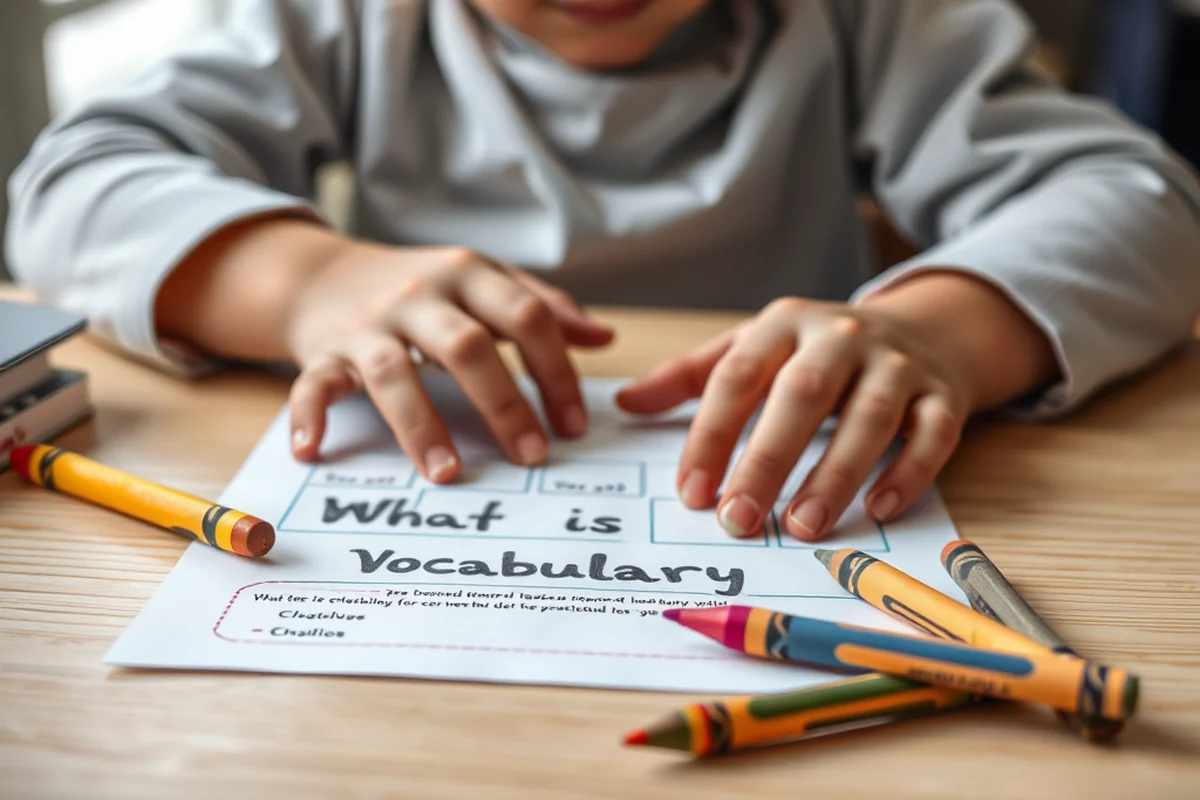
I remember how amazed I was when my daughter started using the word ‘magnificent’ after we played a game where we described things we saw in the park. The game involved taking turns picking an object and describing it with as many words as possible. She loved it and started using more descriptive language naturally.
Play-based vocabulary instruction can be as simple as a scavenger hunt — asking your child to find a ‘round object’ or a ‘red item’ — or as complex as a board game that requires using specific vocabulary to move pieces. These activities not only make learning enjoyable but also help reinforce the meaning of words in context.
I’ve noticed that when vocabulary is taught through play, children are more likely to remember and use the words. It’s like a hidden lesson that doesn’t feel like a lesson at all.
Play makes learning invisible — and that’s where the magic happens.
Related: Teaching vocabulary grade 1
Related: Vocabulary lesson plan
Related: Teaching vocabulary communicatively
Related: Vocabulary lesson plan pdf
The Power of Visual Aids in Teaching Vocabulary
I once used a set of flashcards with images of animals and their names, and I was surprised at how quickly my daughter picked up the words. She would point at the cards and say the words out loud, and it became a fun game for us. I learned that visual aids are a great way to reinforce vocabulary in a way that's easy to remember.
Visual aids also help children who are visual learners — those who remember things better when they can see them. For example, I used a picture book with vivid images and asked my daughter to describe what she saw. This helped her understand and use new words more easily.
I’ve since made a habit of using visual aids during our daily routines. Whether it’s pointing out a ‘triangle’ shape in the kitchen or showing her a ‘circle’ in a toy, these moments have helped her build her vocabulary in a natural and meaningful way.
Create a visual word wall in your home with images and words, or use flashcards during meals or playtime. This helps your child see and use new vocabulary in real life.
“I remember the first time I realized how powerful words could be in shaping a child's world.”— Teaching Vocabulary to Kids editors
Related: Teaching vocabulary through literature
How to Use Stories to Build Vocabulary

I started reading picture books to my daughter every night, and I noticed how much she began to use words from the stories in her own speech. One of her favorites was a book that described a bear’s journey through the forest. She would often reenact parts of the story with her toys, using the words she had learned from the book.
Stories also help children understand more complex words in a way that’s easy to grasp. I remember a story that included the word ‘resilient’ — and I was surprised to hear my daughter use it later to describe how she felt after falling off her bike. That moment showed me how effective storytelling can be in teaching vocabulary.
I now make it a point to read a variety of stories — from fairy tales to nonfiction books — to give my daughter exposure to different types of vocabulary. This has helped her not only grow her word bank but also understand how words can be used in various contexts.
The Role of Repetition in Teaching Vocabulary
I used to think that repetition was boring, but I quickly learned that it's one of the most effective ways to help children retain vocabulary. I made it a habit to use the same words repeatedly in different contexts — for example, saying ‘happy’ and ‘sad’ when describing our day or using ‘big’ and ‘small’ when comparing objects.
Repetition also helps reinforce the meaning of words. I remember how my daughter started using the word ‘silly’ after I used it repeatedly in our conversations. She would point at her brother and say ‘silly’ whenever he did something unexpected, which showed me how repetition helps build vocabulary naturally.
I now use repetition as a strategy during our daily routines — whether it's counting objects, describing feelings, or using specific words in our conversations. This has helped my daughter not only remember words but also use them in her own speech with confidence.
How to Use Technology to Teach Vocabulary
I started using educational apps that had interactive vocabulary games, and I was surprised at how quickly my daughter caught on. One app had a feature where she could listen to a word, see its image, and then use it in a sentence. This made learning vocabulary more engaging and fun.
Technology also helps children learn in their own pace. I noticed that my daughter was more motivated to learn when she could choose the words she wanted to learn and practice them in a game format. This made the process feel less like a task and more like a game.
I’ve also used videos and songs that teach vocabulary in a fun and interactive way. My daughter loves singing along to songs with new vocabulary, and I’ve seen her use the words she learned from the songs in her everyday speech.
Technology can turn learning into a game — and games are where curiosity lives.
The Importance of Encouragement in Teaching Vocabulary
I used to be very strict about my daughter’s vocabulary learning — I would correct her if she used a word incorrectly. But I soon realized that this made her feel discouraged and hesitant to try new words. I changed my approach by focusing on encouragement and praise instead.
I started celebrating her vocabulary progress, even small ones. When she used a new word correctly, I would give her a high-five or say something like, ‘Wow, you used the word ‘happy’ just like in the book!’ This helped her feel proud of her efforts and motivated her to keep learning.
Now, I make it a point to be positive and supportive when teaching vocabulary. I believe that when children feel encouraged, they are more likely to take risks and try new words, which is essential for language development.
🌈 Younger Kids (Ages 2-3)
For younger children, use simple words, short sentences, and lots of visual cues to help them learn vocabulary in a fun and engaging way.
📚 Older Kids (Ages 7-9)
For older children, use more complex vocabulary, stories, and games that challenge their thinking and encourage the use of more advanced words.
🎯 No-Prep Version
Use everyday objects, conversations, and play as your teaching tools — no need for extra materials or planning.
👯♀️ Group Version
Teach vocabulary in a group setting using interactive games, discussions, and collaborative activities that make learning social and fun.
🚀 Extension Activity
Encourage children to create their own vocabulary flashcards, write stories using new words, or even teach the words to a sibling or friend.
| The mistake | Why it happens | The fix |
|---|---|---|
| Teaching vocabulary in isolation | Words are more meaningful when they are taught in context, and children are more likely to remember and use them when they see how they fit into real-life situations. | Use vocabulary in everyday conversations, stories, and games to help children see how words are used in real life. |
| Forcing vocabulary learning | Children are more likely to learn when they are interested and engaged, not when they feel pressured or forced to learn. | Make vocabulary learning fun and interactive. Let your child explore words through play, stories, and games. |
| Ignoring repetition | Repetition helps children remember and use words consistently, but it’s easy to overlook this important strategy. | Use the same words repeatedly in different contexts to help your child build vocabulary naturally. |
| Not encouraging your child | Encouragement is essential for building confidence and motivation, but it’s easy to forget to praise your child’s efforts. | Celebrate your child’s vocabulary progress, even small ones. Use positive reinforcement to help them feel proud and motivated to keep learning. |
What Is Teaching Vocabulary
Common Questions
How can I make teaching vocabulary more engaging for my child?
What are some simple vocabulary activities I can do at home?
How long does it take to see results from teaching vocabulary?
What should I do if my child is struggling with vocabulary?
References
- Patin, Paul Some Techniques for Teaching Vocabulary. ERIC Focus ... (files.eric.ed.gov)
Cite this guide
Teaching Vocabulary to Kids (2026). What Is Teaching Vocabulary. https://wordplayroom.com/what-is-teaching-vocabulary/
Feel free to cite or share this guide.