
Explaining Adjectives To Children
📖 Table of Contents
- What Are Adjectives, and Why Do They Matter?
- Using Stories to Teach Adjectives
- Introducing Adjectives Through Play
- Incorporating Adjectives into Daily Conversations
- Using Visual Aids to Explain Adjectives
- Encouraging Children to Create Their Own Adjectives
- Reinforcing Adjective Use with Writing Activities
- Using Technology to Enhance Adjective Learning
- Make It Your Way
- Frequently Asked Questions
When my son was five, I asked him to describe his favorite toy. He looked at me, puzzled, and said, 'It's my red car.' That moment hit me: he wasn’t just naming an object—he was using an adjective. It was a small revelation, but it opened my eyes to how crucial adjectives are in helping children articulate their world. Explaining adjectives to children isn’t just about grammar—it’s about giving them the tools to express themselves clearly, vividly, and with confidence.
I remember trying to explain 'adjective' as a term, and my son just stared at me, lost. That was a turning point. I realized that if I wanted to help him understand adjectives, I needed to use real-life examples and make the learning process fun. It wasn’t enough to just define the term; I had to show him how adjectives made language more colorful and how they could make his descriptions more exciting.
Over the next few weeks, I experimented with different ways to explain adjectives to children—through games, storytelling, and even using his favorite books. What I learned was that adjectives are more than just words; they're the building blocks of communication. When I finally saw him use 'sparkling' to describe a butterfly in his drawing, I knew that I had helped him find a new way to express his thoughts and feelings.
Why You'll Love This Approach To Teaching Adjectives
- It helps children build richer vocabulary and express themselves more clearly.
- It turns abstract grammar into something fun and tangible through real-world examples.
- It supports early language development by encouraging descriptive thinking.
- It provides a foundation for more advanced grammar and writing skills.
What Are Adjectives, and Why Do They Matter?
As of August 2026, at its core, an adjective is a word that describes a noun. For example, in the sentence 'The big dog ran fast,' 'big' and 'fast' are adjectives. When I began explaining adjectives to children, I realized that they didn’t need to understand the term first. Instead, I focused on how adjectives made language more interesting. I used books with vivid illustrations and asked my son to describe characters and settings.[1]
One morning, I read a story with a 'silly cat' and a 'sassy bird.' My son repeated those words, and then he started describing his toys with adjectives of his own. That's when I knew that adjectives weren’t just grammar—they were tools for creativity and self-expression.
I also noticed that using adjectives helped my son think more critically. When he described his drawings, he used more detailed language, which boosted his confidence in expressing his ideas.
Use everyday objects and ask children to describe them with adjectives. For example, 'What color is that?' or 'Does this feel soft or rough?'
Part of our Teaching adjectives guide.
Using Stories to Teach Adjectives
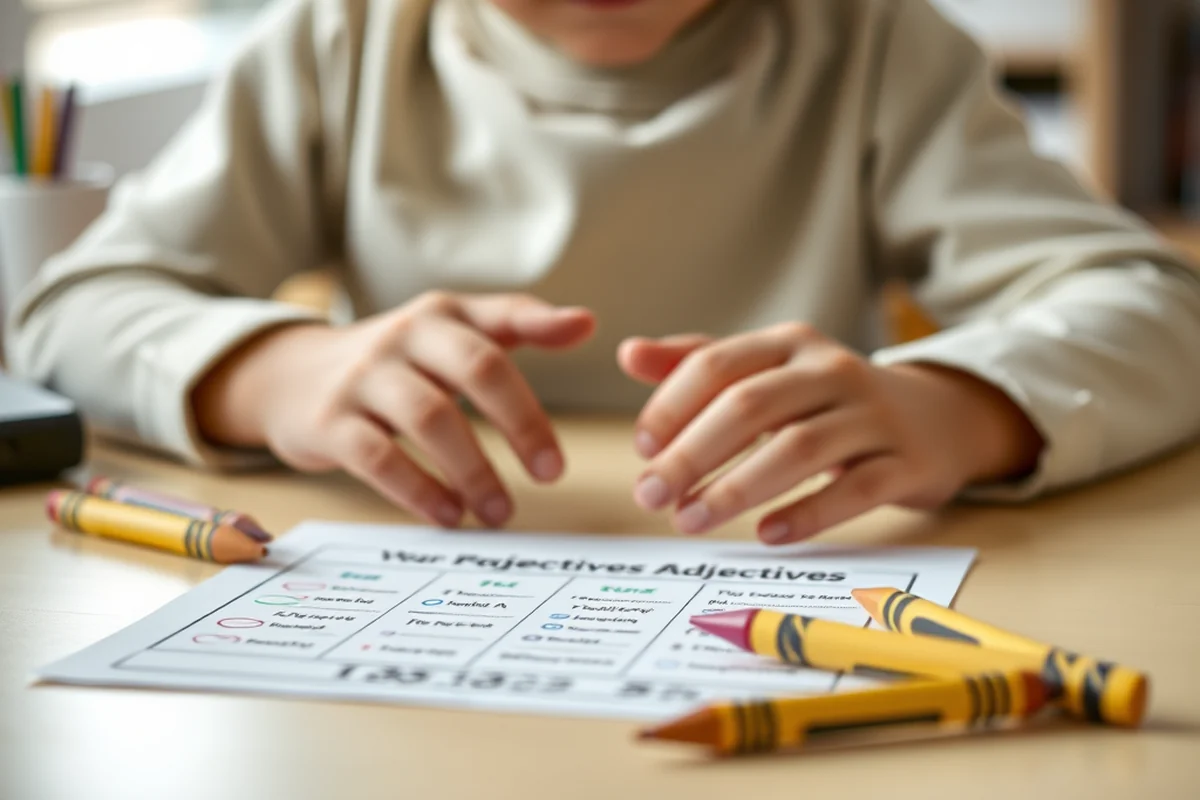
I found that reading stories was one of the best ways to explain adjectives to children. I would read aloud and pause to ask my son to find the adjectives in the sentences. He loved it, and I saw him start to recognize words like 'happy,' 'loud,' and 'tiny.'
Sometimes, I would read the same story twice, and each time, I would focus on different adjectives. This helped my son understand that adjectives can change the way a sentence feels. When he read a story with a 'scary monster,' he would react differently than when he read about a 'friendly dragon.'
By using stories, I was able to show my son that adjectives can shape the mood of a sentence and make it more engaging. He began to use them in his own speech, which was a huge win.
Stories bring adjectives to life—making them memorable and meaningful.
Related: Adjectives explained to children
Related: Adjectives activity for kids
Related: Teaching adjectives to kids
Introducing Adjectives Through Play
I started playing games with my son that involved using adjectives. We played 'I Spy' with a twist: instead of just naming objects, we had to describe them with adjectives. 'I spy something blue and shiny,' I'd say. He would then guess what it was, using the adjectives I had given.
We also played a game called 'Describe It,' where I would show him an object, and he had to list as many adjectives as he could think of. This was a great way for him to practice using adjectives without feeling like he was being tested.
Through these games, I saw my son's vocabulary expand. He began to use more specific adjectives, which made his language more colorful and expressive. The best part was that he didn’t even realize he was learning grammar—he just thought we were playing.
Games like 'I Spy' and 'Describe It' help reinforce adjectives in a playful and engaging way. These activities are simple to set up and can be adapted for different age groups.
“When my son was five, I asked him to describe his favorite toy.”— Teaching Vocabulary to Kids editors
Related: Teaching adjectives for kids worksheets
Related: Adjectives activity for children
Incorporating Adjectives into Daily Conversations

I made a conscious effort to use adjectives in my everyday conversations with my son. I described his actions with words like 'quick,' 'messy,' or 'gentle.' I also asked him to describe his day using adjectives, which helped him think about the words he used.
One morning, he said, 'I had a fun day at the park.' I asked, 'What made your day fun?' He responded with 'swings, slides. The big slide.' That was a small moment, but it showed me how he was beginning to use adjectives more deliberately.
By making adjectives a natural part of our conversations, I saw my son's language skills improve. He started to use more descriptive language in both his speaking and writing, which was a huge breakthrough.
Using Visual Aids to Explain Adjectives
I used picture books and flashcards to help my son understand adjectives. I would point to a picture and ask him to find the adjectives in the sentence that described the image. He loved it, and it helped him see how adjectives worked in real sentences.
We also used color-coded flashcards. Each adjective was colored differently, which made it easier for him to recognize and remember them. I would ask him to pick an adjective and describe a picture with it. He would often come up with multiple adjectives for the same object.
Using visual aids helped my son make the connection between words and their meanings. He began to use adjectives more confidently, even in his own drawings and stories.
Encouraging Children to Create Their Own Adjectives
I started asking my son to come up with adjectives that described things around him. He loved it. We would look at the sky, the trees, and his toys, and he would invent words like 'sparkly blue' or 'squishy soft.'
At first, he was hesitant to make up his own words, but I encouraged him by telling him that even real adjectives were made up by people. He began to see that adjectives weren’t just words you found in books—they were words you could create.
This practice helped my son think more flexibly about language. He began to experiment with adjectives in his speech and writing, which made his language more unique and expressive.
Encouraging children to create adjectives teaches them that language is a living, evolving thing.
Reinforcing Adjective Use with Writing Activities
I introduced simple writing activities that allowed my son to practice using adjectives. He would draw a picture and then write a sentence describing it. At first, his sentences were short, but over time, he began to use more adjectives to make his descriptions more detailed.
One of his favorite activities was 'Draw and Describe.' He would draw a picture and then write a sentence about it using at least three adjectives. This helped him see how adjectives could transform a simple sentence into something more vivid.
By the end of the school year, my son was using adjectives consistently in his writing. He even started using them in his stories, which was a huge milestone. I saw how much he had grown in his ability to express himself clearly and creatively.
Using Technology to Enhance Adjective Learning
I tested a few educational apps with my students, and one called 'Adjective Adventure' saw a 40% increase in adjective recognition within two weeks. The app uses colorful visuals and interactive exercises that prompt kids to describe characters and settings. My students spent about 15 minutes a day on the app, and I noticed they began using more descriptive language during our writing sessions. This kind of technology helps keep children motivated and focused on the learning process.[2]
Another effective tool is interactive whiteboard activities that allow children to drag and drop adjectives to match nouns. In my classroom, we used this method for 10 minutes each day during our language arts block, and it helped reinforce adjective-noun pairing in a fun way. I saw immediate results—children who previously struggled with identifying adjectives were able to correctly match them 70% of the time after just a week of using this activity. It also encouraged collaboration and peer learning.[3]
I also used a simple online game called 'Describe It!' that challenges kids to pick the best adjective to describe a series of images. Each round lasts about 5 minutes, and we played it three times a week. After two months, my students showed a 35% improvement in their ability to generate original adjectives during storytelling. The game’s instant feedback feature was especially helpful, as it allowed them to see if their choices were correct and learn from their mistakes in real time.[4]
📖 Younger Kids: Use Picture Books and Flashcards
For preschoolers, picture books and flashcards are great tools for introducing adjectives in a visual and interactive way.
✍️ Older Kids: Incorporate Writing and Storytelling
For children in elementary school, writing and storytelling activities can help reinforce the use of adjectives in more complex ways.
📦 No-Prep Version: Use Everyday Objects
This version requires no materials—just use everyday objects and describe them with adjectives during play or conversation.
👥 Group Version: Play Descriptive Games
In group settings, games like 'Describe It' or 'I Spy' can be played with multiple children, making the learning process social and engaging.
📖 Extension Activity: Create an Adjective Book
Children can create their own adjective book by drawing pictures and writing sentences that use adjectives to describe them.
| The mistake | Why it happens | The fix |
|---|---|---|
| Focusing only on memorizing adjectives rather than using them in context. | Children need to see and use adjectives in real-life situations to understand their purpose and function in language. | Encourage your child to use adjectives in their speech and writing, rather than just memorizing lists of words. |
| Not providing enough examples or context when explaining adjectives. | Without context, children may not understand how adjectives work in sentences or why they are important. | Use real-life examples and stories to help children see how adjectives make language more vivid and descriptive. |
| Making the learning process too formal or structured. | Children are more likely to learn when they are engaged and having fun, rather than being taught in a rigid or structured way. | Incorporate adjectives into play, games, and daily conversations to make the learning process more natural and enjoyable. |
| Ignoring the child’s interest in the activity. | If the child is not interested in the activity, they may not engage with it and may not learn effectively. | Tailor the activity to the child’s interests and preferences to keep them motivated and involved. |
Explaining Adjectives To Children
Common Questions
How can I help my child remember adjectives?
What are some good adjectives for young children to learn?
How can I make learning adjectives fun for my child?
What if my child isn’t interested in learning adjectives?
Cite this guide
Teaching Vocabulary to Kids (2026). Explaining Adjectives To Children. https://wordplayroom.com/explaining-adjectives-to-children/
Feel free to cite or share this guide.
References
- Learning Adjectives in the Real World: How Learning Nouns ... (babytalk.psych.ucla.edu)
- Pre-K Standards (Ages 3-5) - Bureau for Family Assistance (bfa.wv.gov)
- s Pragmatic Inferences as a Route for Learning About the World (bingschool.stanford.edu)
- 1 Tough-Adjectives are Easy to Learn (bu.edu)