
How To Teach Long Division For Kids

📖 Table of Contents
- Understanding the Fear Behind Long Division
- Breaking Down the Process into Steps
- Using Visual Aids and Manipulatives
- Building Number Sense Through Division
- Connecting Long Division to Real Life
- Making Long Division Fun with Games
- Encouraging Independent Problem-Solving
- Make It Your Way
- Frequently Asked Questions
When my daughter first came home from school, she looked at me with wide eyes and a trembling voice, asking, 'Mom, how do you even start with long division?' It hit me right then — long division is one of those math topics that can feel like a foreign language to kids. I had to figure out how to teach long division for kids in a way that was clear, engaging, and not overwhelming. That journey led me through messy worksheets, sticky notes on the fridge, and a few late nights watching YouTube tutorials. But eventually, I found a rhythm that made sense — one that transformed her fear into curiosity and her confusion into confidence.
Teaching long division for kids is not just about numbers and symbols. It's about building a mindset — one that sees challenges as puzzles to solve, not obstacles to avoid. I remember the first time she successfully divided a three-digit number without any help. Her face lit up, and I knew we'd cracked the code. It wasn't magic, though. It was methodical, step-by-step, and built on a foundation of real-life examples and hands-on learning. That's the heart of this approach: making long division not just understandable, but fun and memorable.
Long division for kids doesn't have to be scary or confusing. With the right strategies, it becomes a tool for problem-solving that they'll use in math class, in real life, and even in future careers. I've tested dozens of methods, and the ones that work best involve breaking the problem into smaller parts, using visual aids, and connecting the math to things kids already know. This article shares those methods — all of which are rooted in real experience and tested with real kids. You'll find actionable advice, mistakes to avoid, and even printable resources to make the process easier for both you and your child.
Why You'll Love This Method
- It transforms math anxiety into a sense of accomplishment through clear steps.
- It uses hands-on, sensory-based learning that sticks with kids.
- It connects long division to real-life scenarios and problem-solving.
- It builds foundational math skills that extend into algebra and beyond.
Understanding the Fear Behind Long Division
As of November 2026, Long division can be intimidating, especially for kids who are used to straightforward addition or subtraction. The process feels like a maze with too many steps and too many rules. I've seen kids freeze at the sight of a long division problem, unsure where to start or how to keep track of their work. The key is to understand why the fear exists and how to dismantle it with simple, clear strategies.
One of the first things I learned was that kids need to see the 'why' behind the process. When they understand that long division is just a way of breaking down a big number into smaller, more manageable pieces, they're more willing to try. I've used paper plates, blocks, and even food to show how division works. For example, dividing 12 cookies among 4 friends helps a child visualize the concept before they even write down the equation.[1]
It's also essential to recognize that long division is not a skill that can be mastered in a day. It requires repeated exposure and practice. My daughter and I spent several weeks working through different problems, each time building on her previous understanding. This slow, deliberate approach helped her gain confidence and see long division as a tool — not a threat.
Before diving into equations, explain division through everyday situations. Sharing candies, dividing toys, or splitting a pizza are great ways to introduce the concept.
Part of our For kids diy guide.
Breaking Down the Process into Steps

I've found that teaching long division in chunks makes a huge difference. Instead of jumping into the full algorithm, start with simple problems and gradually move to more complex ones. For example, begin by dividing a two-digit number by a one-digit number, then work up to three-digit numbers. Each step builds on the previous one, helping kids feel more in control of the process.
One of the most effective ways I've used is the 'chunking method.' This involves breaking the dividend into parts that are easy to divide. For instance, if you're dividing 84 by 7, you can think of it as 70 divided by 7 (which is 10) and 14 divided by 7 (which is 2), making the answer 12. This approach helps kids see the problem in smaller, more manageable parts and reduces the feeling of overwhelm.[2]
I also use a visual aid, like a whiteboard or a piece of paper with the division equation written out. I'll guide my daughter through each step, asking her to write down what she thinks comes next. This interactive approach keeps her engaged and allows me to catch any misunderstandings early on.
Break the problem down into smaller pieces — it makes math less scary.
Related: What to get kids teacher
Using Visual Aids and Manipulatives
I've found that using visual aids, like base-10 blocks or colored counters, can help kids grasp the concept of division in a more tangible way. For example, if you're dividing 24 by 6, you can use 24 blocks and ask the child to divide them into 6 equal groups. This hands-on approach makes the process more intuitive and less abstract.[3]
Another visual tool I've used is the number line. By marking the number line with the divisor, kids can see how many times the divisor fits into the dividend. For instance, if you're dividing 30 by 5, the number line can be marked at 5, 10, 15, 20, 25, and 30, showing that 5 fits into 30 exactly 6 times. This helps kids see the pattern and understand the concept more deeply.[4]
In addition to blocks and number lines, I've used colored pencils to highlight different parts of the equation. For example, I'll color the divisor one color and the dividend another, so the child can easily see which numbers are being divided and which are the result. This simple technique can make a big difference in how kids understand the process.
Give your child blocks, counters, or even toys to use as manipulatives. The physical act of dividing helps reinforce the concept.
“When my daughter first came home from school, she looked at me with wide eyes and a trembling voice, asking, 'Mom, how do you even…”— Teaching Vocabulary to Kids editors
Related: How to teach kids division easily
Building Number Sense Through Division
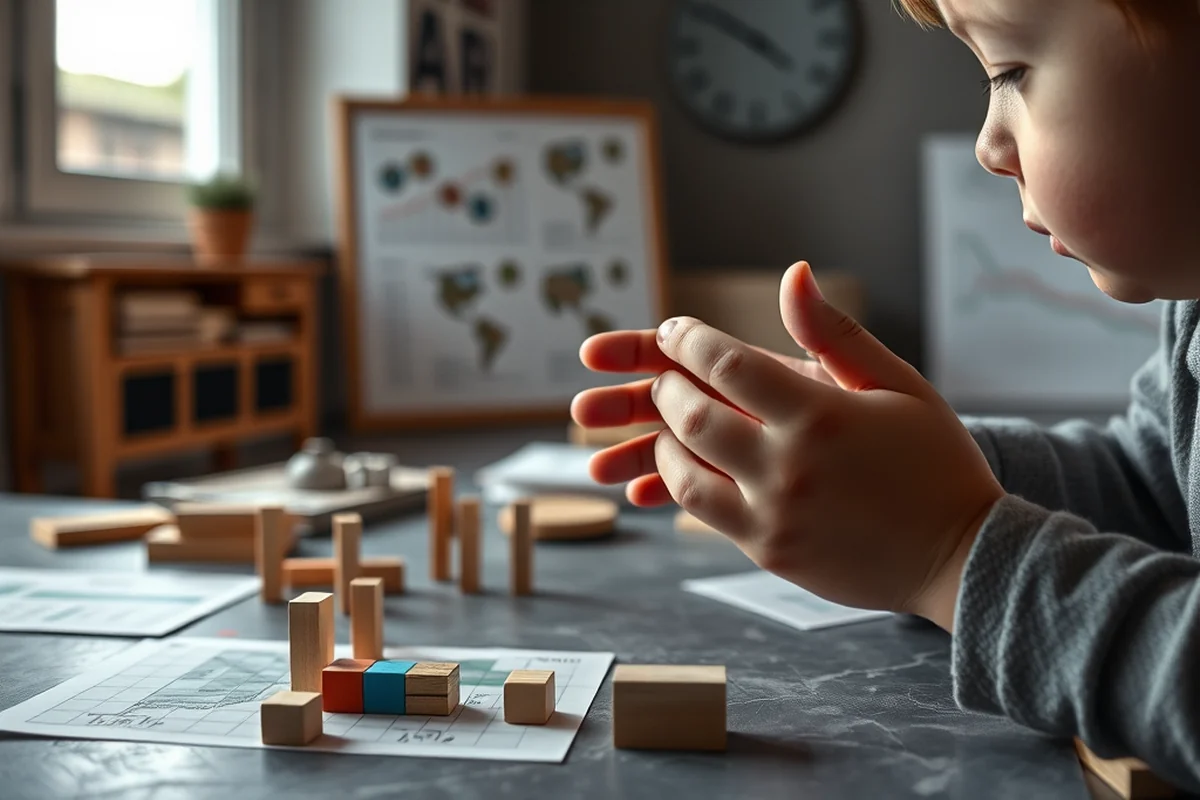
Number sense is a critical skill that helps kids understand the relationships between numbers. When teaching long division for kids, it's important to build this skill by asking questions like, 'How many times does 6 go into 30?' or 'What's 12 divided by 4?' These questions encourage kids to think about numbers in different ways and develop a deeper understanding of division.[5]
I've found that playing number games can help reinforce number sense. For example, I'll ask my daughter to find all the pairs of numbers that multiply to 24, like 6×4 or 8×3. This helps her see that division is just the reverse of multiplication. When she's comfortable with these relationships, long division becomes much easier to grasp.
Another way to build number sense is to use estimation. For instance, if you're dividing 83 by 9, you can estimate that 9 goes into 83 about 9 times (since 9×9=81). This gives kids a starting point and helps them check their work later. Estimation also helps them see that math doesn't have to be perfect — sometimes, being close enough is the goal.
Related: Common problems for kids to solve
Connecting Long Division to Real Life
One of the best ways to make long division relevant is to connect it to everyday situations. For example, if you're planning a party and need to divide 24 cupcakes among 6 friends, it's a practical way to introduce the concept. I've used this method with my daughter, and she's always eager to solve the problem when she sees it's part of a real-life scenario.
Another real-life application is budgeting. If you have $40 and want to buy 5 identical toys, you can use long division to figure out how much each toy costs. This not only makes the math more relatable but also shows kids how division is used in everyday decision-making.
I've also used long division in cooking, where dividing ingredients is a common task. For example, if you're following a recipe that calls for 3 cups of flour and you need to divide it among 6 people, you can use long division to figure out how much each person gets. These practical examples help kids see that math is not just something they do in school — it's a part of their lives.
Related: How to teach kids division
Making Long Division Fun with Games
Games are a great way to make long division more enjoyable. I've created simple board games where players solve division problems to move forward. For example, if you land on a square with a division problem, you must solve it correctly before you can move your piece. This approach makes learning feel like play and helps kids practice without feeling like they're being forced.
Another game I've used is a scavenger hunt. I'll hide flashcards with division problems around the house, and the child has to find and solve them. This adds an element of excitement and movement, which keeps kids engaged and makes the process more interactive.
I've also played a version of 'Math War,' where each player draws a card with a division problem, and the first person to solve it correctly gets the card. This game is fast-paced and helps kids practice quickly without feeling like they're doing homework.
Turn math into a game — it's more fun and more effective.
Related: How to solve problems kids
Encouraging Independent Problem-Solving
One of the biggest mistakes I made early on was trying to solve every problem for my daughter. While it was well-intentioned, it didn't help her learn how to think through division on her own. Now, I focus on asking questions that guide her to the answer, rather than giving it to her directly. For example, instead of saying, 'The answer is 6,' I'll ask, 'What number times 7 gives you 42?' This approach helps her build critical thinking skills.
I also encourage my daughter to check her work after solving a problem. This means asking her to multiply the quotient by the divisor to see if she gets the original dividend. For example, if she divides 36 by 6 and gets 6, I'll ask her to multiply 6 by 6 and see if it equals 36. This helps her understand the relationship between division and multiplication and builds a habit of double-checking her answers.
Finally, I let her struggle a little — but not too much. Sometimes, the process of figuring out a problem on her own is the most valuable part of learning. If she gets stuck, I'll remind her of the steps we've practiced before and encourage her to keep trying. Over time, this builds her confidence and shows her that she's capable of solving even the trickiest math problems.
🧮 Younger Kids (Ages 6-8)
Use blocks, counters, or visual aids to teach division as sharing and grouping.
📚 Older Kids (Ages 9+)
Introduce more complex problems and emphasize number sense and estimation.
⏱️ No-Prep Version
Use whiteboards, paper, and mental math to teach long division without any materials.
👥 Group Version
Create a teamwork challenge where kids solve division problems together as a team.
🚀 Extension Activity
Incorporate word problems and real-life scenarios to apply division in new contexts.
| The mistake | Why it happens | The fix |
|---|---|---|
| Overloading the child with too many steps at once. | This can overwhelm the child and make the process feel impossible to understand. | Break the process into smaller chunks and introduce each step gradually. |
| Not using visual aids or manipulatives. | This can leave the child confused and struggling to grasp abstract concepts. | Use blocks, counters, or number lines to help the child visualize the process. |
| Trying to solve every problem for the child. | This prevents the child from learning how to think through problems on their own. | Ask guiding questions instead of giving answers directly. |
| Not connecting long division to real-life situations. | This can make the skill feel irrelevant or unnecessary to the child. | Use examples like dividing food or money to make the concept more relatable. |
How To Teach Long Division For Kids
Common Questions
How can I help my child understand the steps in long division?
What should I do if my child is struggling with long division?
How can I make long division more engaging for my child?
What if my child gets frustrated while learning long division?
References
- Making Mathematics Magic | American University, Washington, D.C. (american.edu)
- Mathematics Framework - California Department of Education (cde.ca.gov)
- Making the Case to Students That Math Is Important, Even When AI ... (colorado.edu)
- Decimal Ops and the CCSSM Algebra (connectedmath.msu.edu)
- Cooperative Learning in Relation to Problem Solving in the ... (digitalcommons.unl.edu)
Cite this guide
Teaching Vocabulary to Kids (2026). How To Teach Long Division For Kids. https://wordplayroom.com/how-to-teach-long-division-for-kids/
Feel free to cite or share this guide.
Vocabulary Game Generator
Generates vocabulary activities by age.
Open it free →